German


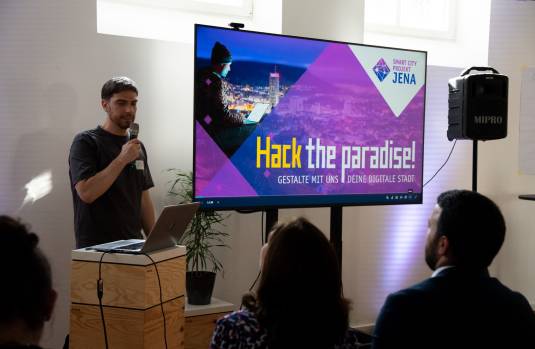
Hack the paradise! 13.06. and 14.06.2025
Design your digital city with us
As a successful innovation hub, our goal is to shape the city of Jena step by step in a future-oriented and sustainable way with the help of digital technologies.
We are counting on the swarm knowledge of our city and want to work together with business, science and civil society on smart solutions for our city. That is why we are inviting developers, creatives, visionaries, students, data experts, designers and interested citizens to Hack the paradise! - the hackathon to shape our (digital) city of the future. Together, we are looking for innovative solutions to make Jena an even better place to live, work and study.
Hackathons - a neologism made up of "hacking" (playful for programming) and "marathon" - come from software development and are collaborative development and design competitions. In interdisciplinary teams, innovative solutions for specific problems and challenges are developed in a short space of time.
As part of the Smart Cities Jena model project, we want to focus on the topic of "artificial intelligence" at the second hackathon. This topic is increasingly finding its way into the various areas of public life and is therefore becoming more and more relevant for administration, companies, science and civil society. By working together with the various stakeholders, future-oriented, practical AI applications can be tested as prototypes for the municipality.
Challenges of the "Hack the paradise!" 2025
Knowledge in a nutshell - AI abstracts for the Jena city lexicon
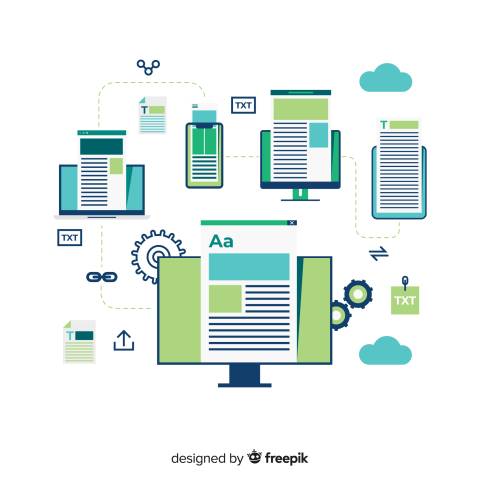
The Smart City Project Jena is digitizing the historical-topographical city encyclopedia - as a living, digital reference work for citizens, researchers and history buffs, the city's history is being made accessible to everyone. But before articles can go online, they need clear structures: title, category, image, geocoordinates - and above all a concise abstract.
Your challenge
Currently, these abstracts are still created by hand - which costs time, resources and nerves. Your mission: Build a data protection-friendly AI prototype that automatically generates a standardized, editable abstract from an article.
Sounds simple? Then do it better than ChatGPT & Co - and show how local AI creates real added value.
Bring history into the future - and help make knowledge usable for everyone!
#City lexicon #LLM #PromptEngineering
- Result
-
As part of the hackathon challenge, the participants received a database dump with articles from the Jena City Encyclopaedia. The aim was to develop a functional, privacy-friendly and AI-based prototype for the automated generation of precise and concise abstracts.
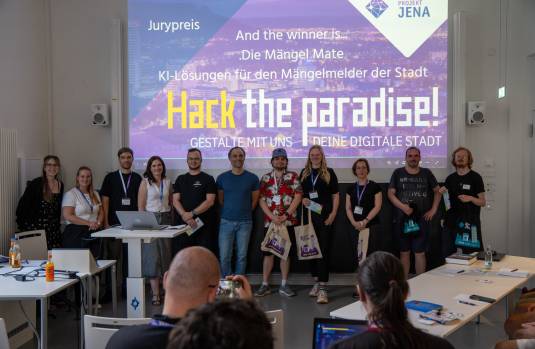
Smart reporting instead of double complaining - intelligent defect detector of the city of Jena

Road damage, broken streetlights, littered parks - all annoying, but also solvable. Jena's defect reporter makes it possible: citizens can report problems in public spaces directly. However, every report has to be manually checked, sorted, moderated, forwarded and checked for duplicates.
Your challenge
Develop an AI solution that automatically analyzes, filters and evaluates defect reports - from spam detection to data protection checks and status updates.
Bonus: Improve communication between the city and citizens with smart feedback in real time and thus accelerate the elimination of defects in our city.
Bring order to the reporting system - and show how AI can give the administration a real tailwind!
#defect reporter #CivicInnovation #AI4Good
- Result
-
For the challenge, participants were provided with an API containing all approved defect reports (location, category, description, status). In addition, an anonymized data set with unreleased reports (e.g. spam, duplicates, content contrary to guidelines) was available. On this basis, the participants developed various solutions and codes. The corresponding GitHub repository is available here: https://github.com/lixhunter/2025hacktheparadise-mangelmelder.
The image processing is based on a Next.js architecture with TypeScript, Tailwind CSS and the Leaflet map library for the geographical location of defects. The repository is licensed under the MIT license, which allows free use, modification, redistribution and commercial use while retaining the license and copyright notices.
In addition, a Python script was developed for automated image processing and classification of defects. It uses a pre-trained YOLOv8 model (Ultralytics) to detect and classify objects such as potholes or garbage and saves the results as annotated images. The aim is to automate defect reports with AI support and make them easy to use, even for less technically experienced users.
In addition, a local LLM service (e.g. with OpenAI or Ollama models) for text classification and response generation has been set up, which enables AI functions without cloud dependency. Another repository deals with the automatic detection and avoidance of duplicates in defect reports based on criteria such as location, description and timestamp.
The city of Jena is currently testing the Github repository and its implementation in the Jena defect reporter.
Insight on site - understanding the customer experience locally

How many people visit a retail store every day? How do events such as city festivals, demonstrations or the weather influence visitor frequency? How many customers are advised and how many customers leave the store without being advised? This information is worth its weight in gold for retailers. Especially now, when retailers in city centers are struggling to survive and the shortage of skilled workers is also noticeable in brick-and-mortar retail, targeted, data-based planning would be a real game changer.
Your challenge
Build a system that analyzes anonymized movement data from video feeds on site - with edge computing, in compliance with data protection regulations and completely without the cloud. Generate comprehensible insights for retailers: for product range planning, room design or staff deployment.
Clear the way for data-based retail - without any surveillance!
#EdgeComputing #Data protection #StoreAnalytics
- Result
-
As part of the challenge "Insight on Sight - Understanding the customer experience locally", a first functional prototype based on a Raspberry Pi and a USB camera was developed during the hackathon. The prototype enables the real-time capture, processing and analysis of video data. The implemented AI analysis recognizes people, classifies gender, estimates age groups, avoids multiple counting and identifies group movements. The developed system is consistently designed to comply with data protection regulations: The analysis is anonymized, without storing personal or identifiable image data, and meets the applicable data protection requirements. The aggregated data evaluation is carried out via a dashboard and forms the basis for the further development of the system.
On this basis, the Initiative Innenstadt Jena e. V. submitted the prototype developed together with the hackathon project team for funding as part of the project call "Digitalization projects in the city centre" of the Thuringian action alliance "Inner cities with a future". The project was selected as one of three state-wide winning projects and will receive funding of up to 15,000 euros. The award-winning AI-supported visitor frequency measurement project enables participating businesses to analyze visitor flows transparently for the first time and base operational decisions on reliable data.
At the same time, the project represents a central link to the city of Jena's Smart City project. The data collected, aggregated in compliance with data protection regulations and the technology developed can be integrated into the city's pedestrian frequency measurement system in the future to enable a more comprehensive analysis of city center movements across all locations. The project thus makes a transferable contribution to digital urban development in Thuringia and can serve as a model project for other cities in the action alliance.
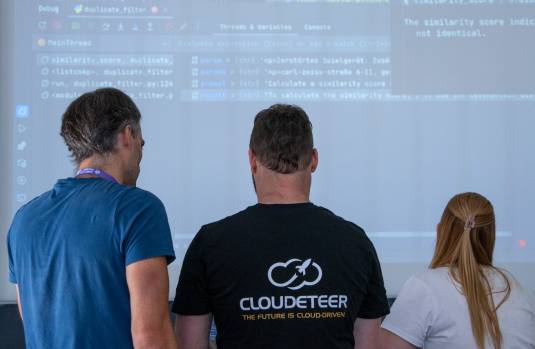
Mentors

Dr. Oliver Mothes
#MachineLearning #ComputerVision #GraphTheory
Transfer Coordinator Science/ Thuringian Center for Learning Systems and Robotics

Johannes Kretzschmar
#RapidPrototyping #Science communication #Programming
Lichtwerkstatt Jena Open Photonics Makerspace / FSU Jena

André Toussaint

Martin Liebeskind
#Agility #Programming #Team
FAQ
You don't need any special skills or hackathon experience to take part in Hack the paradise! Just bring your notebook and the time and desire to work together in interdisciplinary teams on ideas and concepts.
Unless you only want to build sensors, you don't need any programming skills. For most challenges, you or at least someone in your team should have some programming experience. At least as important as programming skills are specialist knowledge of the respective challenges, conceptual know-how, presentation skills, creativity and an affinity for design. Experience has shown that the best ideas come from interdisciplinary teams!
We aim to provide a safe and comfortable environment and a harassment-free experience for all; regardless of the following:
- Gender, gender identity and expression
- Age
- sexual orientation
- Disability
- physical appearance
- Nationality
- Religion
- political views
- previous hackathon participation or lack thereof
- IT experience or not
- chosen programming language or tech stack
We do not tolerate harassment of hackathon participants in any form. Sexual language and imagery is not appropriate at any hackathon venue, this includes the following:
- Hacks
- Talks, presentations, check-ins, workshops or demos
- any parties associated with the hackathon
- social media
- all other online media
Harassment includes offensive verbal comments, intimidation, stalking, following, photographing or audio/video recording without consent, persistent interruption of conversations and unwelcome sexual attention.
Hackathon participants who violate these rules will be asked to cease harassing behavior immediately and may be excluded from the hackathon at the discretion of the hackathon organizers.
Report to the organizing team if participants behave inappropriately in any of the above points.
Let's create a fair environment for everyone together!
We want to improve the quality of life, communication, networking and cooperation in the city through jointly developed and implemented innovations.
To this end, the city's existing networks from business, science, administration and urban society will be activated and encouraged to help shape urban life.
In the process of developing a data policy, a common understanding and a practiced approach to handling data will be developed that pays particular attention to the protection of personal data and the transparency of public data.
The ability to cooperate, collaborate and jointly develop third-party funding will be improved through networking and collaboration. The Smart City project (Jena Digital Werkstadt) is creating a networking and collaboration platform through which the city of Jena implements, exchanges and further develops digital solutions with partners.
We want to promote selected project ideas. This is always done in close coordination with the jury, the challenge givers and the hackathon project teams. This involves looking for implementation options, discussing possible costs and networking with institutions that could be involved. As organizers, we reserve the right to release financial resources for the implementation of project ideas following Hack the paradise! Codes used for this purpose will be made open source under a strong copyleft license, as this is a prerequisite for the use of the funding in the Smart City project.