
 German

Monitoring committee provides important impetus for the future - digital agent for schools continues to gain momentum
Today, the monitoring committee of the Digital Agent for Schools sub-measure met for the third time - and once again it became clear how much energy, expertise and joint creative will this format contains. This committee is a real driving force for the Smart City project: this is where the ideas and feedback are generated that not only accompany the transfer process, but actively drive it forward.
The digital agent is a new type of personnel category that is being tested for the first time in Jena - with the clear aim of creating a blueprint that could also be anchored throughout Thuringia in the long term. This is precisely why the monitoring committee's perspective is so valuable: the different perspectives from the state level, local authorities, academia, civil society and practice help us to continuously sharpen the job profile and strengthen the interfaces between these areas.
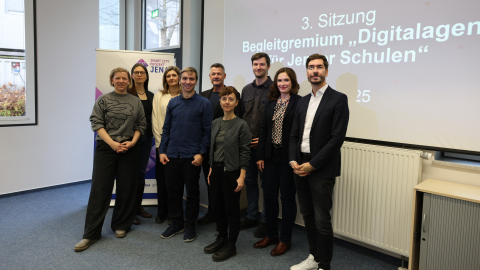
Today's meeting focused in particular on the progress made in the model schools and the current strategy developments for digitalization at state level. It is clear that there is a great need for professional support in the digital transformation - and the digital agent fills precisely this gap. The participants discussed which developments are particularly promising and how successful formats can be systematically expanded.
In the photo (from left): Dr. Iren Schulz (TMBWK), Dr. Christina Walther, (witelo e.V.), Melanie Hey (ThILLM), Christoph Voigt (Digitalagent Jenaer Schulverwaltung), René Ehrenberg (Jenaer Schulverwaltung), Stefanie Teichmann, Jan Wiescholek, Dorothea Prell (all three Smart City Project Jena) and Prof. Dr. Alexander Gröschner (FSU Jena)
The measure is gaining momentum: cooperation with the schools is becoming ever closer, initial routines are emerging and feedback from the colleges confirms how valuable such locally anchored support is. For the Smart City team, it is clear that something sustainable is being created here that can have an impact beyond the project.
With the quarterly meetings, the process remains closely monitored and flexible enough to quickly address new needs. At the same time, the focus is increasingly on the future: how can we process the experiences from Jena in such a way that a model for the entire country can emerge? What structures are needed in the long term? And how can we ensure that schools continue to receive competent support after the project ends?
One thing became clear again today: the digital agent is more than just an experiment - it is a signpost for the future of digital education in schools. And the advisory board plays a crucial role in providing expert advice.