
 German

One year of digital agents at Jena's schools
How Christoph Voigt brings digitalization to life
Christoph Voigt has been supporting three Jena schools as a digital agent for a year now - a measure within the Jena Smart City project. He supports teachers in integrating digital media into their lessons in a safer, more relaxed and more meaningful way. What initially sounds like a technical task is, in practice, above all relationship work. Listening, removing uncertainties, providing guidance and showing how digital possibilities can really enhance learning.
When Christoph looks back on the past twelve months, he is particularly struck by the attitude of the teaching staff. "The commitment here is enormous. Many teachers invest additional time - on top of everything they already do - just to further develop their teaching. That really impressed me."
Further development often happens in small moments. A brief introduction to the school cloud suddenly replaces the USB stick. A clarifying conversation allays fears. A shared look at digital tools leads to a spontaneous "Aha, that's so much easier!" This is exactly how digital self-confidence develops bit by bit.
A year of classification - and lots of questions
Christoph speaks openly about the hurdles at the beginning, as the role of digital agent was initially unfamiliar to many.
"I first had to listen a lot to understand where the needs were. Technology is available in almost all schools - but the question is: what do teachers need so that they experience this technology as a relief and can really improve their teaching?"
It quickly became clear that it is not enough to simply implement analog methods digitally. In a rapidly changing and complex world, we need forms of learning that are flexible, collaborative, visual, creative and that go beyond what is possible in traditional lessons.
In order to find out where schools are on this path, Christoph conducted surveys among the teaching staff and head teachers. These help schools to realistically assess their situation by revealing which structures they have in place, where strengths and uncertainties are apparent and which further steps are sensible and feasible.
"It is important to understand where a school currently stands. Only then can we jointly consider which steps really make sense."
Important support for teachers
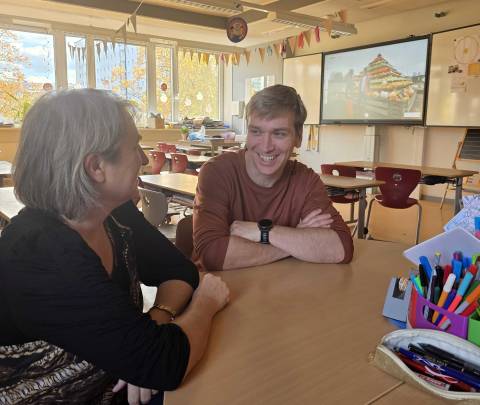
Anja Walther, a primary school teacher at the "Saaletalschule" in Lobeda-West, describes how valuable this support is in everyday life. She has been working closely with Christoph for a year now.
"Christoph is a huge support. I have much more motivation to deal with digital possibilities because I know that there is someone I can ask."
She reports that digital content is a great help, especially when lessons need to be made more vivid in bad weather - for example on the subject of hedgehogs, botany or school gardens.
"The children love it when we can watch videos together, try things out or compare them."
At the same time, it is important to her that digital tools do not replace everything: Children should still be able to work by hand, and lessons must work even if technology fails.
Anja Walther is open about the fact that she is not the only teacher who invests additional time in further digital training.
"Actually, every school needs someone like Christoph Voigt. The challenges are similar everywhere."
The digital agent is currently supporting the Saaletalschule elementary school, the "An der Trießnitz" community school and the Adolf-Reichwein-Gymnasium grammar school. Other schools in Jena are benefiting from the pilot project through networking events.
Where the school is now heading
All three schools are now showing that digital media have arrived in the classroom. Some teachers are cautiously trying out new forms of learning, while others are leading the way and providing bold impetus. It is crucial that school administrators support this process and allow freedom - and that Christoph's offers are welcome everywhere.
"So far, all doors have been open to me at all schools. That shows that the will is there to make a difference together."
Christoph has clear goals for the coming year. Together with the schools, he wants to develop a structured way to actively shape their future in a digital world. He also wants to make the knowledge that already exists within the teaching staff more visible and strengthen formats in which teachers can learn from each other.
A central claim of the project is its sustainability. Structures that are now being created should be designed in such a way that they function independently of individual people. Christoph is building a broad network and working closely with local and regional partners to ensure that this knowledge does not remain tied to individual people. Permanent cooperation partners are the Jena Media Center and the Thuringian Institute for Teacher Training, Curriculum Development and Media (ThILLM). There are also close contacts with the Thuringian Ministry of Education and the Friedrich Schiller University Jena, in particular the Chair of School Pedagogy and Teaching Research. His position is located in the school administration of the city of Jena.
In this way, a stable foundation is being created step by step that will reliably support the development of the digital school beyond the duration of the project.
In the end, he sums it up himself:
"Digitalization doesn't just mean that we have new devices. It changes how we work together, how we communicate and how we learn."
After a year in the field, it is clear that this change has long since begun - with commitment, tangibly and together with those who fill the school with life every day.