German


Less Data, Same Benefits: How Jena Can Use Its Sensor Data More Efficiently
A datathon at Friedrich Schiller University in Jena yields promising approaches for resource-efficient municipal data management
When is traffic volume on Jena’s streets particularly high? How do temperatures change within the city? And how does air quality change throughout the day? Sensors provide the city of Jena with a multitude of daily measurements that form an important basis for traffic planning, urban development, and monitoring environmental conditions.
However, as the volume of available data increases, so does the effort required to store, process, and analyze it. Several terabytes of sensor data are generated annually. This consumes storage capacity, incurs costs, and requires energy. But do all the collected measurements actually need to be permanently stored in their original form?
A Question from Everyday Administrative Life
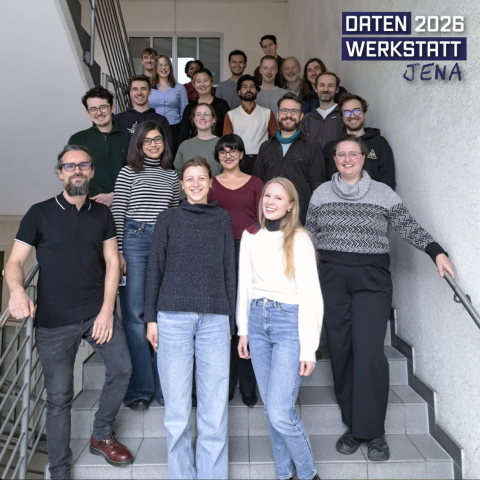
With this question, the City of Jena participated in the “Datenwerkstatt Jena 2026,” the datathon organized by Friedrich Schiller University Jena, which took place from October 7 to 9. In this format, students from various disciplines work together to address concrete, real-world problems.
Under the title “Against the Data Deluge—How Much Is Enough?”, a team used municipal sensor data collected over several days to investigate how the volume of data to be stored could be reduced without compromising the validity of relevant analyses.
Up to 95 percent reduction in data volume
The city administration’s Data Management and Statistics team subsequently conducted a technical evaluation of the proposed solutions. The results indicate significant potential for savings:
Weather data: For measurements such as temperature, air pressure, wind speed, and precipitation, the data volume could be reduced by up to 80 percent. Using mathematical methods known as spline regressions, time series can be represented with significantly lower storage requirements.
Traffic data: By aggregating measurements by time intervals and lanes and using statistical metrics, the data volume was reduced by 90 to 95 percent.
Important information relevant to the analysis objectives was retained in the process. Instead of permanently storing every single measurement value, data can be specifically condensed for certain applications.
What does this mean for Jena?
A smaller data volume can help speed up analyses, reduce the need for technical infrastructure, and lower storage, operating, and energy costs in the long term. At the same time, important data foundations for municipal planning and decision-making processes are preserved.
The city of Jena now aims to implement the developed approaches in practice and assess to what extent these methods can be applied to other municipal datasets.
In this way, the Datathon also provides impetus for implementing the city’s data strategy. After all, a smart city is not defined solely by collecting as much data as possible, but above all by using the available information in a targeted, responsible, and resource-efficient manner.
The collaboration between the university and the city administration demonstrates how scientific methods can contribute to solving very specific municipal challenges and how Jena is leveraging its scientific and digital expertise for urban development.