
 German


Jena Through Your Eyes: "Avatar" Wows the Crowd at the Smart Country Convention 2026
Lea, the student; Helga, the retiree; Felix, the scientist; and Dorothea, the expert: At the Smart Country Convention in Berlin, we brought digital urban development to life from a variety of perspectives. Our avatar, presented for the first time, captivated the convention audience—and served as a conversation starter for an in-depth exchange with local governments, policymakers, and businesses.
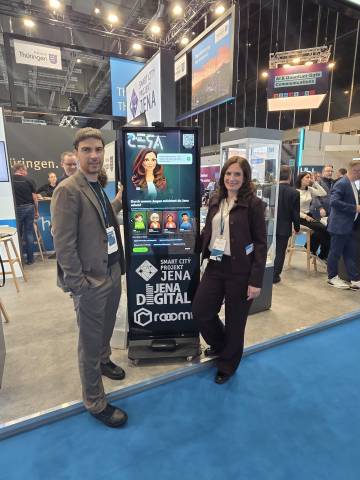
How is digitalization changing our everyday lives? What does a smart city offer the people who live there? At the Smart Country Convention (SCCON) in Berlin from October 13 to 15, 2026, we gave these questions a face—or, more precisely, several faces.
The centerpiece of our trade show presentation was a new exhibit that we unveiled to the public for the first time in collaboration with Jena Digital e. V.: an avatar that takes on various roles and presents our smart city projects from the perspectives of different people. In this way, the presentation of digital solutions became a vivid encounter with the people for whom we develop them.
Lea, Felix, and Dorothea Bring the Smart City to Life
Whether it’s Lea as a student, Felix as a scientist, or Dorothea as an expert: each of these personas offers a unique perspective on the digital city. They introduce our projects and help visitors understand their benefits from the context of different life situations.
ArtKonTor developed the concept for the avatar, while rooom handled the technical implementation. Together with Jena Digital e. V., this resulted in an exhibit that showcases the expertise and creativity of our Jena network.
The response to the premiere was overwhelming. The avatar sparked curiosity, generated great enthusiasm, and got us into conversations with numerous visitors. That’s precisely what made it a special highlight of the fair for us: it provided direct access to topics that often seem abstract at first.
Great Interest in Jena’s Experiences
Many municipalities approached us specifically at the fair to learn more about our projects, ask specific questions, and get tips for their own initiatives. How can digital services be designed to be easily accessible? What has proven effective in practice? And what lessons can other cities and municipalities apply to their own work?
Topics of discussion included our “ProbierLaden,” which provides free support for digital questions without requiring registration, and the Jena Digital Innovation Hub (JEDI), which brings together government, business, academia, and engaged citizens. The digital 3D city model and the expanded digital payment options offered by Jena’s citizen services also demonstrated the diverse ways in which digitalization can make a difference locally.
For the City of Jena, SCCON was a valuable opportunity to present these experiences to a broad audience of experts, make new contacts, and strengthen existing partnerships. At the same time, we took away ideas that will enrich our own work.
Together at the booth, together in development
Our presentation was part of the Thuringian joint booth. Together with partners from the Free State of Thuringia, we demonstrated what can be achieved through collaboration between municipalities, the state, and businesses. The city of Mühlhausen also contributed its experiences and approaches.
Right next to us, Data In Motion presented the new version of the urban data platform. It was jointly developed based on the previous version. This made it clear at the booth what lies behind many digital offerings: the ongoing work on a technical foundation upon which municipal applications can be built.
From the avatar as a visual entry point to the data platform as a technical foundation, our joint trade show presentation showcased different facets of digital urban development and how closely they are interconnected.
Inspire today, ensure long-term impact
In addition to presenting our projects, the focus was on a key question for the future: How can successful offerings continue to exist and be further developed beyond the current funding period? For Jena, the funding phase under the federal “Smart Cities Model Projects” program ends in August 2027.
The visit on Wednesday by Thuringia’s Minister for Digital Affairs, Steffen Schütz, and State Secretary Milen Starke provided an opportunity to discuss this in person. The discussion centered on Jena’s experiences and the prospects for the long-term use of the solutions, structures, and partnerships that have been established.
This exchange is crucial for us. What we have built together with our partners should benefit people in the long term. SCCON provided an important framework for this: here, we were able to bring together municipal practices, political perspectives, and possible next steps.
Our team was represented by Overall Project Manager Dorothea Prell, subproject managers Heike Stötzner, Stefanie Teichmann, Stefan Schwarz, and Domenique Dölz, as well as Urban Data Coach Björn Walther.
Back to Jena with new contacts and fresh ideas
The three days of the conference demonstrated just how great the interest in Jena’s projects is—and how much potential lies in exchange across city and state borders. Our avatar conveyed in a particularly vivid way what we’re all about: shaping digitalization from the perspective of people.
We’re taking home from Berlin enthusiasm for our new exhibit, valuable contacts, and concrete ideas for further collaboration. For Jena, SCCON thus served as a powerful platform and an important meeting place to take the next steps toward a digital future together.
Working Together for a Digital Thuringia: Smart City Jena at SCCON 2026
How can we achieve digital transformation that truly benefits local residents? And how can cities and the state work together to ensure that successful projects remain sustainable in the long term? With these questions in mind, the City of Jena’s Smart City team attended the Smart Country Convention (SCCON) in Berlin from October 13 to 15, 2026. Together with partners from Thuringia, Jena presented concrete solutions for digital urban development and used the event to hold important discussions about its future.
For three days at the Smart Country Convention, representatives from politics, government, business, and academia gathered to discuss the digital future of cities, regions, and public administrations.
Thuringia was represented with a joint exhibition booth, in which the Jena Smart City Project and Jena Digital also participated. Together with the Thuringian Ministry for Digital Affairs and Infrastructure (TMDI), rooom, and other partners, they demonstrated how digital innovations are being advanced collaboratively in the Free State of Thuringia. The city of Mühlhausen, another Thuringian municipality, also presented its experiences and approaches.
The joint presentation was more than just a showcase of individual projects. It highlighted how closely the city of Jena and the state of Thuringia are collaborating on digitalization and how important this exchange is for turning good ideas into long-term, practical solutions.
Jena Shows What’s Already Working
At the joint booth, the Smart City team presented various projects that have emerged in Jena over the past few years. These included the “ProbierLaden,” which provides people with free support for digital questions without requiring registration, and the Jena Digital Innovation Hub (JEDI), which brings together government, business, academia, and engaged citizens.
The digital 3D city model and the expanded digital payment options offered by Jena’s citizen services also demonstrated just how versatile municipal digitalization can be. While the city model, for example, opens up new possibilities for urban planning and the vivid visualization of developments, digital administrative services make people’s everyday lives easier in a very tangible way.
Another exhibit was a new AI avatar that interactively introduces the Jena Smart City project. It was showcased as part of the trade show presentation and offered additional insight into the potential of artificial intelligence in communicating municipal projects.
The Jena Smart City team was represented by overall project manager Dorothea Prell, as well as the two subproject managers, Heike Stötzner and Domenique Dölz, and project manager Vanessa Huber.
Thinking Ahead Together: Discussions on the Future of Smart City Projects
A particular focus of the trade show was on exchanges with representatives of the Thuringian state government. On Wednesday, Thuringia’s Minister for Digital Affairs and Infrastructure, Steffen Schütz, and State Secretary Milen Starke visited the joint booth and spoke with the Jena team.
The discussion centered in particular on how the experiences and results from the Jena Smart City project can be utilized and further developed in the long term. This is because the current funding phase of the nationwide “Smart Cities Model Projects” program ends for Jena in August 2027.
In recent years, numerous initiatives, structures, and partnerships have emerged. The task now is to jointly develop strategies for how successful approaches can continue to have an impact even after the funding period ends.
The discussions in Berlin built on the existing close and constructive collaboration between the City of Jena and the Free State of Thuringia. At the same time, they highlighted how important it is to link municipal practical experience with state-wide digitalization strategies.
“In Jena, we’ve achieved an incredible amount in recent years together with many partners. Now the question is how we can leverage these experiences and successful initiatives in the long term and, of course, ensure their sustainability. Close cooperation with the State of Thuringia is particularly important for this. We are experiencing a very open and constructive exchange here, as well as a shared interest in not only initiating digitalization but also making a lasting difference. The fact that we are appearing together at SCCON and discussing the next steps is therefore an important signal for us,” said Dorothea Prell.
Renate Mitterhuber, head of the “Smart Cities and Regions” division at the Federal Ministry of Housing, Urban Development, and Construction, was also present at SCCON. The Federal Ministry supports the Jena Smart City project as part of the Smart Cities Model Projects program.
Learning from Jena, Reaping Benefits Together in Thuringia
For the Jena team, SCCON was also an opportunity to look beyond their own city limits. After all, many municipalities face similar questions: How can digital services be operated sustainably? How can we get as many people as possible on board? And how can successful solutions be developed in a way that allows other cities and municipalities to benefit from them as well?
This is precisely where a major opportunity for cooperation between municipalities and the state of Thuringia lies. Practical experience can be shared, existing networks strengthened, and solutions further developed collaboratively.
The three days of the trade show in Berlin demonstrated once again just how important this exchange is. Jena not only contributes its own experiences and projects but also takes away new ideas and contacts to build on in its future work.
After all, a digital future isn’t created by new technologies alone. It requires people working together on solutions, governments learning from one another, and partners who are willing to take on long-term responsibility.
This is precisely what the collaboration between Smart City Jena and the State of Thuringia stands for: shaping digitalization together so that it makes a difference locally.