German


Robby is coming to daycare centers in Jena: Discovering the digital world through play
How do robots, electrical circuits, and digital processes work? With a small wooden robot, children at 14 daycare centers in Jena will soon be able to explore these questions for themselves. What makes this special is that Robby works with almost no screen at all. He is part of the “Smart Daycare Centers” smart city project, through which the city of Jena aims to strengthen early childhood media education in the long term.
What happens when a robot doesn’t understand a command? Why is the order important when brushing your teeth? And what do these two questions have to do with each other? More than you might think at first. That’s because many everyday processes are based on principles that underpin digital technologies as well. With the little wooden robot Robby, children will be able to discover these connections for themselves in the future by trying things out, experimenting, and working together to find solutions.
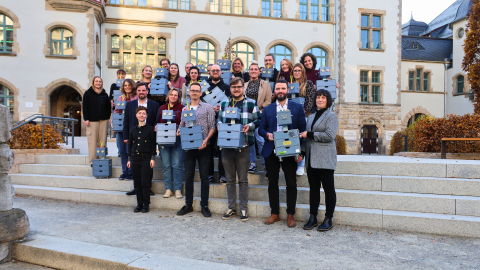
On November 10, 2026, Robby was officially welcomed at the Volkshaus Jena. The Thuringian State Media Authority (TLM) presented the educational materials to the city of Jena in the presence of Mayor Benjamin Koppe and Johannes Schleußner, head of the education department. A total of 14 daycare centers in Jena are participating in the program. The STEM education partner witelo e. V. will also receive a Robby kit.
Digital education doesn’t start on a screen
At first glance, Robby looks like a small wooden robot with drawers. Inside, however, there’s plenty of material for discovery and experimentation. The concept, developed by the TLM, is aimed at children ages five to seven and teaches them the basics of the digital world.
They don’t need to be able to read or program to participate. They build simple circuits, learn about robots in their everyday lives, and experiment with how movements can be controlled through clear instructions. When one child guides another—like a robot—through an obstacle course, it quickly becomes clear why the correct sequence and clear instructions are important. Along the way, the children learn the basic principles of algorithms.
“Digital education doesn’t start at the screen. Children can also discover the logic behind digital processes through movement, play, and experimentation,” explains Andrea Bätzig, a media educator at TLM.
A responsible approach to the subject is crucial here. Children are growing up with digital technologies, but they shouldn’t spend as much time as possible in front of screens as early as possible. Rather, the goal is to tap into their curiosity, explain technical concepts in an age-appropriate way, and gently introduce them to the digital world.
First the educators learn, then the children
Before Robby is introduced in the daycare centers, the educators themselves have the opportunity to get to know him in detail. On November 10 and 11, they attended a two-day training session organized by TLM at the Volkshaus. During the session, they tested the materials, familiarized themselves with the various learning modules, and explored how the concept can be meaningfully integrated into the daily routine of the daycare centers.
This is an important component of the “Smart Daycare Centers” smart city project. After all, new technology alone does not create good digital education. The people who provide educational guidance are crucial.
This is precisely where the city of Jena has been stepping in since September 2025 with a comprehensive training program. Early childhood educators are being trained as media coaches, learning about digital applications, creative media work, and screen-free media education. They are then expected to share the knowledge they’ve gained at their facilities and support their colleagues with questions about digital media.
Robby now adds another practical resource to the mix. Instead of having to develop their own concepts, educators can draw on proven methods and ready-made learning materials.
For Johannes Schleußner, the head of the Department of Education, this is also an important approach. Children must be introduced to the digital world in an age-appropriate manner—not too early—and with child protection in mind. This requires well-qualified professionals and programs that tap into children’s curiosity.
Turning Professional Development into Long-Term Collaboration
However, the project does not end with the handover of the Robby boxes. On the contrary: The city of Jena wants to continue the work done so far and embed the skills developed in the facilities for the long term.
That is why a new network of media experts is being established as part of the “Smart Daycare Centers” initiative. Here, already-qualified professionals will regularly exchange ideas, share experiences from their educational work, and jointly consider which topics and training programs will be important in the future.
For Mayor and Head of the Digitalization Department Benjamin Koppe, this idea is particularly important: “Our main goal here is to build knowledge and skills that can then be passed on and utilized within the facilities.”
The network is intended to ensure that collaboration among the daycare centers continues even after the Smart City funding ends. This will allow professionals to learn from one another and work together to further develop media education in Jena.
Robby Isn’t Alone
The Jena-based association witelo e. V. is also participating as a partner. Together with the participating daycare centers, “experiment days” are planned, during which children can deepen their new knowledge and conduct further exploration. An additional Robby box is available for loan at witelo so that other institutions can also familiarize themselves with the materials.
The Robby boxes themselves are manufactured at the Christophoruswerk in Erfurt in a workshop for people with disabilities and are funded by the Sparkassen-Finanzgruppe Hessen-Thüringen.
In this way, the project combines several approaches: Children discover how digital technologies work through play. Early childhood educators receive the knowledge and materials they need to guide the children in this process. And the new network creates a foundation on which Jena’s daycare centers can continue to share their experiences with one another in the future.
Further Information
- Smart City Project: “Smart Daycare Centers” Subproject
- Robby Project of the Thuringian State Media Authority: Publication