
 German

Seven spots up—and what's behind it
Jena has improved its ranking in the 2026 Smart City Index. But even more intriguing than its ranking is the question of what digital urban development actually means in everyday life.
73.0 points. Ranked 47th out of 83 major German cities. Seven spots higher than last year. And fifth place among cities with 100,000 to 149,999 residents.
Those are Jena’s figures from the 2026 Smart City Index.
But what do they tell us about a city?
With its annual ranking, the digital association Bitkom examines how far digitization has progressed in major German cities. This is by no means limited to how many administrative services are available online. The assessment covers public administration, energy and the environment, mobility, IT and communication, as well as society and education.
Jena scores particularly well in the latter area. And behind this category are very specific places, projects, and people.
When Digitalization Becomes Part of Everyday Life
Anyone who walks into the ProbierLaden on Engelplatz rarely asks, “Just how digital is Jena, anyway?”
The questions are much more concrete. How does the new smartphone work? Is online banking secure? What can artificial intelligence actually do, and how do I use it?
This is precisely part of Jena’s vision for a smart city: digitalization shouldn’t remain abstract. It must become understandable, allow for hands-on experimentation, and support people in using digital opportunities independently. The ProbierLaden has become a highly sought-after hub for this purpose.
A few streets away, JEDI takes a different approach—but with the same underlying idea. Here, the city’s residents, academia, business, and the next generation come together. Workshops, hackathons, and events create a space to learn about new technologies, develop ideas further, and connect people with one another.
Digital urban development doesn’t just require technology. Sometimes it also needs a door that anyone can simply walk through.
Data that tells a story about the city
Other smart city projects are less immediately visible in everyday life but form important foundations.
With the WISSENsAllmende, Jena is developing an urban data infrastructure that allows information to be aggregated, linked, and made available for various applications.
One example of how this can yield concrete benefits is the measurement of foot traffic in the downtown area. It provides insights into how public spaces are used and how visitor flows are changing. In this way, data is transformed into knowledge that can support urban development and planning.
In this way, Smart City Jena covers a broad spectrum: from data infrastructure and sensor technology to personalized consulting at the “ProbierLaden,” and from technical applications to spaces for exchange and innovation.
“The fact that Jena is particularly well-positioned in the areas of society and education aligns very well with our understanding of a smart city,” says Dorothea Prell, Smart City Coordinator and Overall Project Manager for the City of Jena. “For us, the key is not to produce as many digital projects as possible. We want to create structures that function sustainably, reach people, and provide concrete benefits for the city.”
Why a ranking is still important
This is exactly where the Smart City Index comes into play. A ranking can never fully capture a city’s development. In addition, Bitkom regularly refines its methodology, criteria, and data sources. The seven-place jump up the rankings therefore cannot simply be equated with an equally large increase in actual digital performance.
Nevertheless, the comparison is valuable. It offers Jena an outside perspective: Where does the city stand in a nationwide comparison? Where are its strengths? In which areas are other cities further ahead? And which topics are gaining importance across Germany?
This perspective is not only of interest to the city administration. Digital infrastructure, modern administrative services, mobility, educational opportunities, and an innovation-friendly environment are increasingly becoming key factors in a city’s quality as a location. They play just as important a role for citizens as they do for businesses, academia, skilled workers, or potential partners.
Mayor and Head of the Digital Department Benjamin Koppe therefore sees the result as both a confirmation and a mandate: “Moving up seven spots to fifth place among cities of our size sends a strong signal. For us, however, our position in the ranking is not the actual goal. What matters most is that digitalization reaches people, makes everyday life easier, and creates favorable conditions for a modern hub of science and business.”
And perhaps that is precisely the more important story behind 47th place: Digitalization isn’t just about points and rankings. It’s about whether data becomes knowledge, technology becomes a tool—and a digital project becomes something that remains part of everyday life in the city.
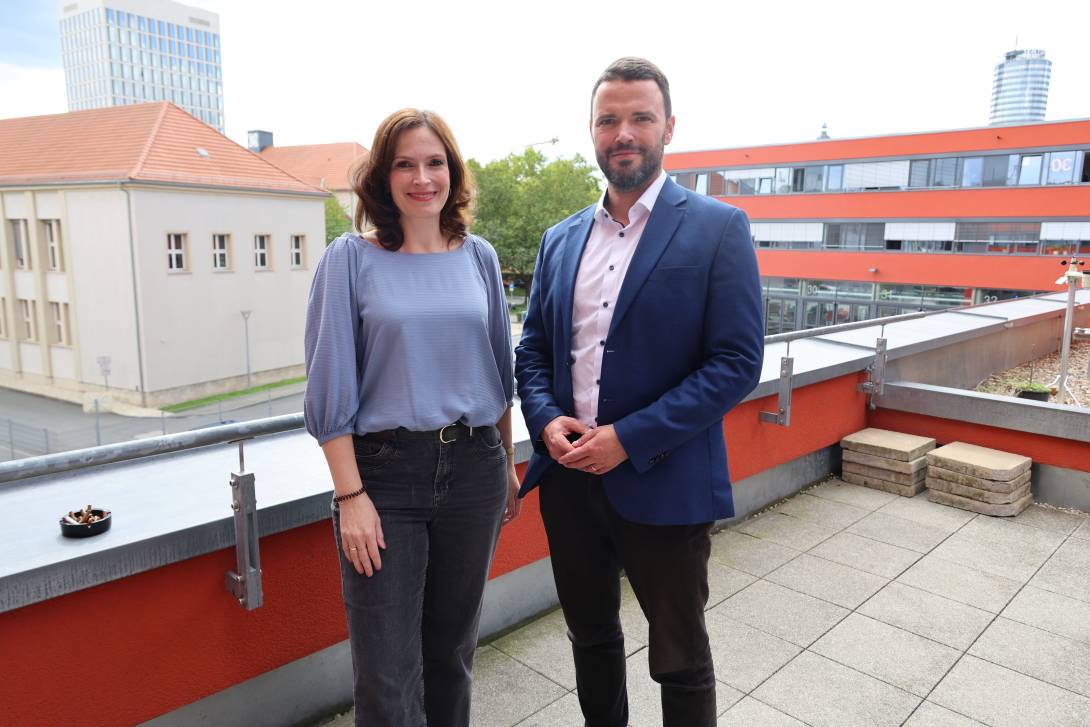
Reason to celebrate for Dorothea Prell, overall project manager for Smart City, and Mayor and Head of the Digitalization Department Benjamin Koppe: Jena has moved up seven spots in the 2026 Smart City Index and ranks fifth in its size category.