
 German

Two years, two places—and quite a lot of life in between
The ProbierLaden and JEDI are celebrating their second anniversary. Mayor Benjamin Koppe visited both locations as part of the “Jena im Einsatz” initiative. It was a morning that showed: Digital transformation requires technology. But above all, it requires people who are willing to engage with one another.
Sometimes digitalization starts with a very simple question: How do I transfer my photos from my old phone to my new one? Sometimes with the worry of making a mistake while doing online banking. And sometimes with an idea for a new digital business model, a workshop on artificial intelligence, or the question of how to get research into practical use more quickly.
Just a few minutes’ walk apart, there are two places in Jena where exactly these kinds of questions are welcome: the ProbierLaden on Engelplatz and the JEDI (Jena Digital Innovation Hub) in the Postcarrée.
Both were created as part of the Smart City project; the ProbierLaden was even established in cooperation with the Jena Adult Education Center. Both have been around for about two years now. And during that time, both have evolved into something that could only be partially anticipated at the time of their opening: places where people are happy to return again and again.
To mark their second anniversary, Mayor and Head of the Digitalization Department Benjamin Koppe visited both facilities as part of his “Jena in Action” series. The JEDI celebrated its anniversary back in August; the ProbierLaden will turn two on September 26.
At the ProbierLaden, many things start with a question—and often end with a conversation
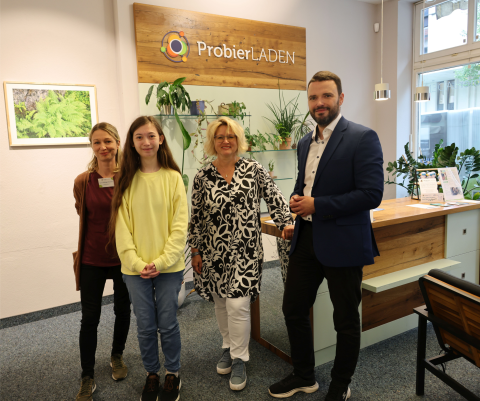
This morning at the ProbierLaden, the focus isn’t on cutting-edge technologies. Here, it’s all about the concrete aspects of everyday life: the smartphone, an app, a password, a bank transfer, or a new feature that suddenly looks different from yesterday.
Older people, in particular, take advantage of the service. About 79 percent of visitors are 66 or older. They come, for example, with questions about smartphones, apps, data security, online banking, or computers. But parents and children also find their way here—for instance, when it comes to media use, child-safe settings, or other topics related to media education. And artificial intelligence? It’s long since ceased to be a niche topic; rather, it’s something that now engages multiple generations.
But anyone who describes the ProbierLaden merely as a digital advice center is only telling half the story.
Because amid the PC café, introductory courses, and information evenings, something has emerged over the past two years that’s hard to measure in numbers: connection.
Here, a former professor might sit next to someone receiving a basic income. People with completely different life paths strike up conversations, help one another, or discuss how to evaluate information online, how to spot fake news, and what digital media are doing to our democracy.
In short: It’s all about people—and quite a lot of them, at that.
“When we discussed the concept of a ‘ProbierLaden’ like this, we knew, of course, that there was a need for support with digital issues. What we couldn’t have foreseen at the time was just how important this place would become for so many people. Today, it’s long since been about more than just technology. People strike up conversations, support one another, and meet others they might never have encountered in their daily lives,” says Dr. Angela Anding, director of the Jena Adult Education Center.
No one here is trying to sell anything
Perhaps part of the success lies precisely in what the ProbierLaden isn’t. It’s not an electronics store. It’s not a showroom. It’s not a place where you’re expected to sign a contract after getting advice.
The services are free of charge, and the ProbierLaden is backed by the City of Jena and the Jena Adult Education Center. This municipal framework builds trust.
“Many people come with the feeling: Here, I can ask questions without being pressured to buy something afterward. This trust is incredibly important. At the same time, we hear time and again: ‘It’s great that the city is providing this kind of service for us and that counseling and education are available free of charge,’” Sara Delinger, ProbierLaden project coordinator
It’s now quite clear that the concept has been well received: By early September, 6,979 people had been reached at the ProbierLaden alone. Of these, 5,474 took advantage of individual one-on-one counseling, and 1,505 participated in courses, information evenings, or other educational programs. In addition, 740 people were reached through the ProbierMobil.
The program has expanded accordingly: a PC café, introductory courses for smartphones or computers, information evenings on data protection, AI, or digital IDs, and other offerings that are developed based on demand. The team collaborates with organizations such as the Consumer Advice Center, the police, citizen services, and media educators, among others.
For Mayor Benjamin Koppe, this is precisely where one of the town’s particular strengths lies: “The high demand at the ProbierLaden shows that there is a concrete need for personalized support with digital issues. New devices, apps, and digital services are evolving rapidly and aren’t equally intuitive for everyone. This makes low-barrier programs—where people can ask questions and receive practical help—all the more important.”
A few minutes away: same basic idea, completely different atmosphere
The walk from the ProbierLaden to JEDI takes only a few minutes. In terms of content, however, the leap is much greater.
While someone at Engelplatz might be setting up an app for the first time, at Postcarrée the focus is on software development, cybersecurity, extended reality, artificial intelligence, research transfer, or new business models.
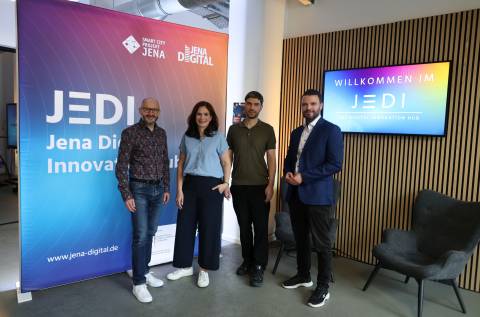
And yet, the two places have more in common than meets the eye. JEDI, too, thrives on people not just consuming information, but working together, discussing ideas, and experimenting.
Since it opened, around 300 events with approximately 8,500 participants have taken place here—an average of about twelve per month. High school students, college students, companies, startups, the scientific community, government agencies, and politicians all use the spaces.
Yet the JEDI is deliberately not a traditional event space with fixed seating and a set program. Sometimes a workshop, sometimes a meetup, sometimes a hackathon, seminar, or specialized event: the spaces can be flexibly adapted, and that’s exactly what makes them appealing to a wide variety of groups.
But what happens between events is even more important.
Individual events have evolved into regular specialist groups. Visitors have become a community. And these encounters consistently lead to new connections, ideas, and collaborations.
“JEDI works because very different people come together here. Some attend a specialized event, others a meetup, a hackathon, or a seminar. But often, the most exciting things happen right in between: People strike up conversations, get to know someone from a different field, and suddenly a new idea or collaboration emerges. The fact that we can use the spaces so flexibly fosters exactly this kind of openness,” explains Domenique Dölz, subproject manager for the Smart City project and cluster manager at Jena Digital e. V.
The Value Lies in What’s in Between
Perhaps, after two years, this is precisely where the connection between ProbierLaden and JEDI becomes apparent.
At the ProbierLaden, a question about a smartphone setting can turn into a conversation about fake news. At JEDI, a meetup can lead to a new collaboration.
Not everything can be captured in statistics. But it’s an essential part of what both places have come to represent.
“ProbierLaden and JEDI clearly demonstrate just how different approaches to digitalization can be,” says Dorothea Prell, Smart City Coordinator and Overall Project Manager for Smart City Jena. “One place focuses on very specific everyday issues, while the other focuses on education, innovation, and new ideas. For us, the two go hand in hand: digitalization must be understandable and accessible, but at the same time it must also create spaces where new things can emerge.”
And what happens after the funding ends?
As both projects mark their second anniversary, the perspective on them is shifting. The question “Does the idea work?” is increasingly giving way to “Which aspects should remain in the long term?”
The experiences gained over the past two years provide an important foundation for this. The high usage rates, the growing collaborations, and the returning communities show that both spaces are meeting a real need. These experiences are already being incorporated into discussions about which structures and formats can be sustained beyond the project’s duration.
Benjamin Koppe clearly articulates the goal: “The past two years have shown that both initiatives have been well-received and meet a concrete need. Our goal is therefore to create opportunities so that successful structures like the ProbierLaden and JEDI can continue beyond the funding phase. We’re currently working hard on this.”
After two years of ProbierLaden and JEDI, one insight stands out in particular: digitalization requires digital infrastructure. But for it to truly benefit people, it sometimes needs, above all, a table, a few chairs—and a place where someone says: Come on in, just ask.