
 German

Platform for Best Practices: Network for Digital Schools Meets at Otto-Schott High School
At the third networking event held at Otto-Schott-Gymnasium, schools in Jena met with partners from the fields of education, science, and business. What began as an annual gathering has now evolved into a network where connections can lead to concrete support.
Anyone who wants to advance digital education at a school doesn’t always have to start from scratch. Sometimes the right workshop already exists. So does the right extracurricular learning venue. Perhaps there’s even a company, an initiative, or a college that’s a perfect fit for the idea currently being discussed by the faculty.
The real challenge is often something else: we need to know about each other.
That was precisely the focus of the third networking meeting for Jena schools on the topic of digitalization, held on September 10, 2026, at the Otto-Schott-Gymnasium. Numerous teachers came together to learn about available resources, share experiences, and, above all, talk to people who can support schools with digital and media education topics.
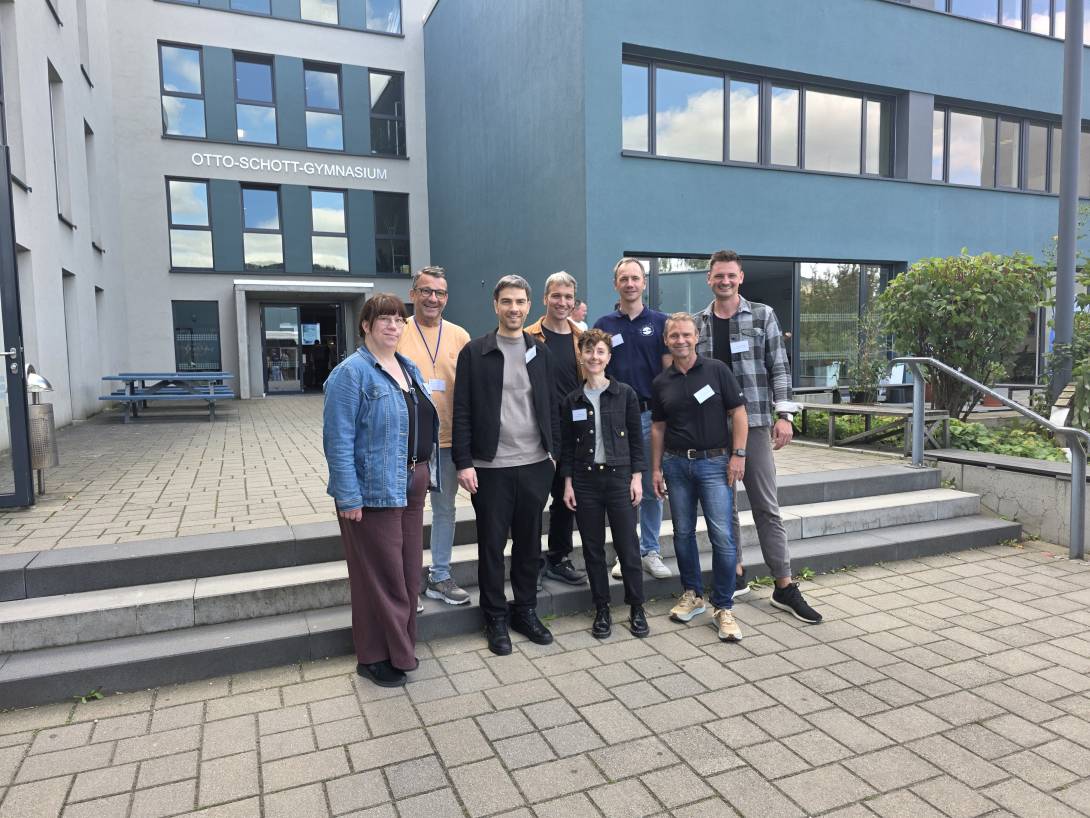
At the third networking meeting organized by Digital Agent Christoph Voigt (center) at the Otto-Schott-Gymnasium, it became clear what the network is all about: bringing people together, sharing experiences, and fostering new collaborations for digital education at Jena schools.
And this time, much of it could be explored right on site.
17 exhibitors—and many potential answers to the question: Who can help us?
New to the third meeting was the “Market of Opportunities.” Seventeen exhibitors from Jena and the surrounding region presented offerings in media and media education, artificial intelligence, STEM, gaming, research, and culture.
Teachers were able to try out digital tools, explore lesson ideas, and ask very specific questions: Is this a good fit for my school? Can we turn this into a joint project? Who is my point of contact for this?
The spectrum ranged from materials and workshops to counseling services and extracurricular learning venues, all the way to potential long-term collaborations.
The fact that the meeting took place at the Otto-Schott-Gymnasium this time was therefore more than just a matter of location. The school itself also took the opportunity to make new contacts—and to promote an exchange from which schools can benefit not only individually but collectively.
“Schools cannot meet the challenges of digital transformation on their own. We need to exchange ideas with one another, but we also need partners outside the school system who can contribute new perspectives, expertise, and concrete offerings. That’s why we’re very pleased that this third networking meeting is taking place here and that representatives from the business community are also engaging in dialogue with schools. In my view, a digital agent who establishes such connections and supports schools in finding suitable partners is an enormous asset to Jena’s school system. To be honest, all schools need this kind of support,” emphasizes Christian Herrmann, principal of the Otto-Schott-Gymnasium.
A lot is already available. But does it actually find its way into the schools?
This is exactly where Christoph Voigt’s work comes in. As a digital agent in the Jena Smart City Project, he connects schools with potential partners, raises awareness of available opportunities, and helps turn an idea into a concrete next step.
Together with a team from the Media Studies Advisory Service at the Thuringian Institute for Teacher Training, Curriculum Development, and Media (ThILLM), he took the lead in organizing the third networking meeting.
After all, Jena already has numerous resources and areas of expertise related to digital education. But these are of little use to a school if it isn’t aware of them.
“In my work as a Digital Agent, I see time and again that schools have very specific ideas or needs but don’t automatically know what resources are already available to address them or who the right point of contact might be. This is exactly where the third ‘Digitalization and Schools’ networking meeting in Jena comes in. We bring schools together with stakeholders from education, academia, and business, highlight opportunities, and help turn an initial contact into concrete collaboration. On the one hand, I’m naturally very pleased that so many teachers are taking advantage of this opportunity; on the other hand, it also shows me just how great the need is for such formats,” says Christoph Voigt.
When Schools and the Digital Economy Get to Know Each Other
Collaboration with Jena Digital e. V. also played an important role this year.
Together with Christoph Voigt, Domenique Dölz—Smart City subproject leader and cluster manager for the Digital Economy & Science—brought additional contacts from Jena’s business community into the network. Both opened the event with a keynote on collaborations between schools and extracurricular stakeholders in media education.
The focus was less on abstract network structures and more on a very practical question: How can schools find exactly the partners that match their ideas and needs?
And above all: How can an initial meeting lead to more than just an exchange of contact information?
The goal is to make existing offerings from business, academia, and media education more accessible and to foster collaborations that support schools in the long term, ease the burden on teachers, and open up additional learning opportunities for students.
At the “Market of Opportunities” that followed, this vision became a tangible reality.
Among the participants were the DLR_School_Lab Jena, witelo, the Lichtwerkstatt Jena, programs from the Ernst Abbe University of Applied Sciences focused on artificial intelligence, Radio OKJ, Jena eSports, and the “ProbierLaden” at the Jena Adult Education Center.
Companies and startups also presented their ideas. PlayInsight Studios from Jena, for example, demonstrated how curriculum content can be brought to life on screen in a playful way.
So what started as “What’s actually going on here?” quickly turned into “We could try that at our school.”
A meeting has turned into a community
The fact that this was already the third networking meeting highlights something else: the format has evolved.
It’s no longer just about gathering new ideas once a year and then going our separate ways. A network has emerged among the schools themselves where knowledge can be passed on, experiences shared, and questions discussed together.
After all, many challenges are similar, even if each school ultimately has to forge its own path.
“In Jena, a lot is already happening in the field of digital education. From the perspective of media education consulting, however, it’s just as important that positive experiences aren’t confined to individual schools. Events like these create an important framework for that: Teachers see that others face similar challenges, can learn from one another, and share successful approaches. This has now given rise to a community of its own, where members advise and support one another. It is precisely this exchange that is indispensable for sustainable media education,” says Ilona Gregor, media education consultant.
In this role, she oversees and coordinates media education training programs on behalf of the Thuringian Ministry of Education, Science, and Culture (TMBWK), which is responsible, among other things, for the Thuringian School Portal and its associated media education offerings.
By Teachers, for Teachers
Just how valuable this exchange can be was also evident in the subsequent workshops.
The focus here was not on theoretical concepts, but on experiences from everyday school life. Guided by the principle “By teachers, for teachers,” the discussions centered on what has already proven effective:
Which digital methods work in the classroom? What experiences can colleagues share? Which solution that works at one school might also help another?
This brought us full circle. After all, digital education doesn’t arise solely from devices, software, or new technologies. It emerges where people know whom to ask, share their experiences, and are willing to learn from one another.
And sometimes, a new collaboration doesn’t start with a grand concept, but with a conversation at a “market of possibilities.”
The third networking meeting was organized in close collaboration with Jena Digital e. V. as well as the media studies consultants from the Thuringian Institute for Teacher Training, Curriculum Development, and Media (ThILLM)—Ilona Gregor, Olaf Heinrich, and Tobias Reichard.